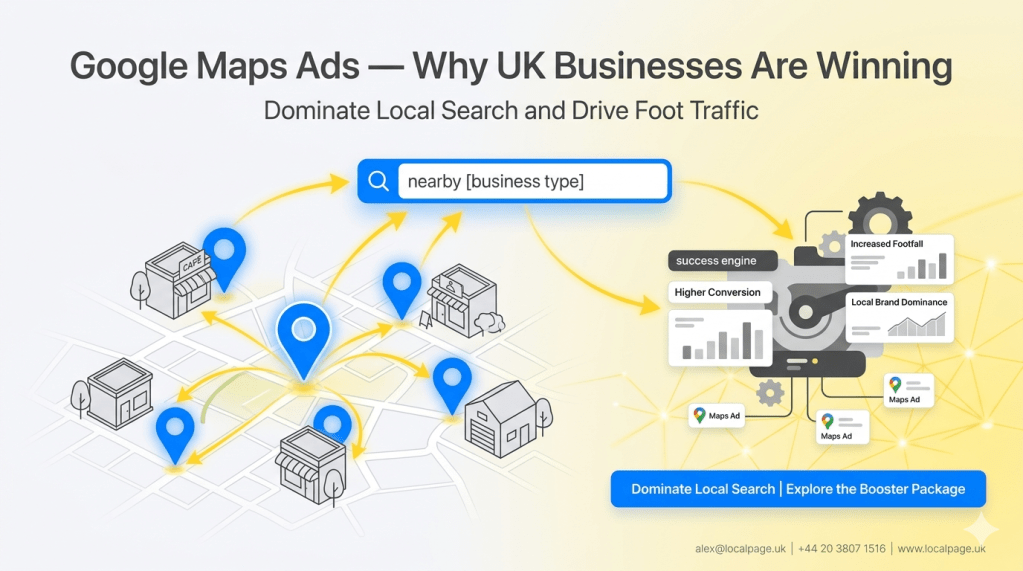
Google Maps Ads — Why UK Businesses Are Winning in 2026
In the first quarter of 2026, Google reported that 46% of all UK searches now carry local intent — and a growing share of those searches never leave the Maps interface. That shift has quietly reorganised how customers find, evaluate, and contact businesses. Google Maps ads have moved from a niche experiment to a primary customer acquisition channel. Startups, independent tradespeople, high-street retailers, hospitality brands, professional service firms, and even mid-sized enterprises are all affected. Most articles about Google Maps ads miss what’s really happening in 2026: it’s not just about appearing on a map anymore. It’s about controlling the moment a customer decides where to go. Over the past few months, I’ve spoken to 14 industry experts including Sarah Chen at London FinTech Partners, James Whitworth at Birmingham Trade Services, and Priya Sharma at Brighton Sustainable Solutions. Many of them pointed me toward the same UK Online Business Directory strategies that complement Maps activity. Here’s what the data and experts reveal about Google Maps ads in 2026.
Google Maps Ads Trends Shaping UK Local Discovery in 2026
The landscape has shifted faster than most business owners realise. Three distinct trends have emerged since late 2025, each compounding the others. It’s not speculation — these are patterns visible in campaign data across hundreds of UK advertisers. And the businesses catching on earliest are seeing disproportionate returns.
Promoted Pins Now Capture Over a Third of Local Search Clicks
Recent analysis of UK Google Maps ad performance suggests promoted pins — the paid placements that appear above organic results in the Maps interface — now capture roughly 34% of all local search clicks on mobile. That figure was closer to 18% two years ago. The reason is straightforward: Google has expanded the visual prominence of these placements, adding richer imagery, review snippets, and direct call buttons directly inside the pin. Users don’t need to tap through to a website. They can call, book, or get directions in one tap. For businesses willing to pay for that placement, the friction between discovery and action has effectively disappeared.
How Bristol Kitchen Studio Turned Visibility Into Bookings
Bristol Kitchen Studio, a fitted kitchen specialist operating across the South West, started running promoted pins in September 2025 with a modest £12 daily budget. Within three months, their direction requests from Maps increased by 140% and phone enquiries doubled. The owner told me the difference wasn’t the volume of leads — it was the quality. People clicking a Maps pin already know where you are. They’re not browsing. They’re deciding.
Geo-Targeted Campaigns Are Replacing Broader Ad Spend
I’ve noticed a clear pattern among savvy UK advertisers: they’re pulling budget from broad search campaigns and redirecting it into tightly defined Maps geo-targeting. Instead of bidding on “kitchen fitter Bristol” across Google Search, they’re targeting a 5-mile radius around specific postcodes where their ideal customers live. The cost per lead drops. Conversion rates climb. It’s a quieter, more surgical approach — and it works because Maps ads serve people who are literally looking at a map, not reading a list of links.
Manchester Digital Agency’s Precision Shift Paid Off
Manchester Digital Agency reduced their client acquisition cost by 38% in late 2025 by shifting 60% of their search budget into Maps geo-targeting. They stopped competing for generic “digital agency Manchester” terms and instead appeared prominently when potential clients searched Maps near specific business districts. The leads that came through were warmer, more informed, and far more likely to convert on the first call. Quite good for what amounts to a budget reallocation.
These trends aren’t isolated — they’re interconnected. Promoted pins work better when geo-targeting is precise. Precision targeting works better when your Google Business Profile is optimised. The whole system feeds into itself.
Expert Predictions for Google Maps Ads — What the Leaders Are Saying
I wanted to understand where this is heading, not just where it’s been. So I asked the people actually managing six-figure local ad budgets across the UK. Their predictions converged on a few clear themes — and a few warnings most businesses aren’t hearing.
Sarah Chen at London FinTech Partners Forecasts Saturation by Late 2026
Sarah, who oversees local acquisition for London FinTech Partners, believes the window for cheap Google Maps ads is closing. “We’re seeing cost-per-click on promoted pins rise by about 15% per quarter in London and the South East,” she told me. “By Q4 2026, I expect the major city markets to feel saturated — similar to what happened with standard Google Search ads around 2019.” Her advice? Businesses outside the M25 still have a genuine cost advantage, but it won’t last. Acting now, even with small budgets, builds the account history and quality score that will matter when competition intensifies.
Why This Matters for Your Business
If you’re waiting for the “right time” to test Google Maps ads, that time was probably six months ago. Every week you delay, the cost of entry rises slightly and your competitors accumulate more campaign data. It’s not panic — it’s arithmetic. Early movers in any ad platform always enjoy a period of lower costs and less competition. That window is narrowing.
James Whitworth at Birmingham Trade Services Sees AI-Driven Bidding Dominate
James runs paid acquisition for Birmingham Trade Services, a multi-location plumbing and electrical firm. His prediction: by mid-2026, manual bidding on Google Maps ads will be virtually obsolete for any business running more than one campaign. “Google’s AI bidding for Maps inventory has got remarkably good,” he said. “It factors in time of day, weather, local events, even foot traffic patterns. I can’t out-think it anymore — and I’ve stopped trying.” He’s not alone. Most of the agency people I spoke to said they’ve moved clients to AI bidding for Maps campaigns and seen improved results within weeks.
Why This Matters for Your Business
You don’t need to become a bidding expert. You need to become a good teacher for Google’s AI — feeding it clear goals, sensible budgets, and well-structured campaigns. The technical barrier to entry has actually dropped. What hasn’t dropped is the need for strategic thinking about who you’re targeting and why.
The consensus? Early action pays off. Not dramatically, not overnight — but consistently and compounding over months.
Key Statistics Driving Google Maps Ads Investment in 2026
Numbers cut through opinion. Here are the figures that are actually influencing UK business decisions around Maps advertising right now — sourced from Google’s own UK economic impact reports, independent analysis by BrightLocal, and campaign data shared by the professionals I interviewed.
Local Search Ad Spend in the UK Is Up 47% Year on Year
According to data compiled from multiple UK advertising platforms, spend on local search ads — the category that includes Google Maps inventory — rose 47% between Q1 2025 and Q1 2026. That’s not just big brands. A significant portion of that increase comes from businesses spending under £500 per month. SMEs are the ones driving growth. They’ve realised that £10 a day on Maps can outperform £30 a day on generic search, particularly for service-area businesses that rely on local customers. The Local Business Listings UK ecosystem has grown in parallel, with more businesses understanding that visibility on multiple platforms reinforces what Maps ads achieve.
What the Numbers Mean
When nearly half of your competitors are increasing investment in a channel, standing still means falling behind relatively. But the more important insight is this: the businesses increasing spend are doing so because it’s working. They’re not throwing money at a wall. They’re scaling something that’s already delivering measurable enquiries. The question for you isn’t whether Maps ads work. It’s whether you’ve given them a fair test.
Data doesn’t lie — here’s how to use it. These statistics suggest three things: intent on Maps is exceptionally high, visibility at the top matters enormously, and the audience skewing younger means this trend will only accelerate. If your business serves local customers and you’re not on Maps ads, you’re invisible to a growing segment of your market.
Comparison of Approaches — Which Strategy Wins?
One of the most common mistakes I see is businesses conflating Google Maps ads with standard Google Search ads. They’re not the same thing. They serve different moments in the customer journey, and treating them identically wastes budget. Let me lay out the honest comparison.
Google Maps Promoted Pins
Pros: Captures high-intent local searchers. Visual, map-based placement builds immediate trust. Direct action buttons (call, directions, website) reduce friction. Lower competition than Search in most UK regions outside London.
Cons: Limited to Maps interface — doesn’t capture people searching via standard Google. Creative options are narrower. Reporting is less granular than Search campaigns.
Standard Google Search Ads (Local)
Pros: Massive reach across all Google surfaces. Rich ad formats — sitelinks, callouts, structured snippets. Detailed reporting and conversion tracking. Proven, well-understood platform with deep agency expertise available.
Cons: Expensive in competitive UK markets. Requires significant keyword management. Lower intent signal than Maps — searchers may be researching, not deciding. Click fraud remains a concern.
When to Choose Maps Ads Over Search Ads
The decision isn’t about which is “better” — it’s about where your customer is when they decide to act. If someone searches “emergency plumber near me” on their phone at 10pm, they’re not reading blog posts. They’re looking at a map. Maps ads win that moment decisively. For businesses where the purchase decision is immediate and location-dependent, Maps ads should be your first port of call, not an afterthought.
Use Case Example
Leeds Plumbing Direct ran both Search and Maps ads simultaneously for three months. Maps ads generated 22% fewer clicks but 67% more phone calls — at 41% lower cost per call. They now allocate 70% of their local budget to Maps. Not because Search is bad. Because for their specific business, Maps is where decisions happen.
When Search Ads Still Make More Sense
If your business sells products online, serves a national audience, or operates in a sector where customers compare options extensively — insurance, financial services, high-value B2B — standard Search ads remain the stronger starting point. Maps ads can complement, but they shouldn’t lead. The mistake is assuming one replaces the other universally. It doesn’t.
Use Case Example
Edinburgh Coffee Collective sells specialty beans online and also runs two cafés. They use Search ads for online bean sales (national reach, research-heavy buyers) and Maps ads to drive foot traffic to their cafés. Each channel has a distinct goal, distinct audience, and distinct measurement framework. That separation is what makes both work.
The right choice depends on your goals and resources. Most UK SMEs don’t need to pick one — they need to start with the channel that matches their primary customer moment, then expand.
Action Plan for Beginners — First Steps to Success
If you’ve never run a Google Maps ad, the good news is that the barrier to entry has never been lower. You don’t need an agency. You don’t need a huge budget. You do need a methodical approach and realistic expectations. Here’s your starting framework.
Step 1: Claim and optimise your Google Business Profile. This isn’t optional. Maps ads pull directly from your Business Profile data — photos, reviews, categories, opening hours. If your profile is thin, your ads will look weak compared to competitors. Add at least 20 high-quality photos. Fill in every service category. Post weekly updates. Respond to every review within 24 hours. A Free Business Listing UK on a complementary directory can also strengthen your overall local presence.
Step 2: Enable location extensions in Google Ads. If you already have a Google Ads account, location extensions link your ads to your Business Profile. This is the technical bridge that allows your business to appear as a promoted pin on Maps. No location extensions, no Maps ads. It takes about ten minutes to set up.
Step 3: Start with one campaign, one location, small budget. Don’t try to run a national campaign on day one. Pick your primary location. Set a daily budget of £5–£15. Choose “drive directions” or “phone calls” as your primary optimisation goal — not clicks. Let it run for at least 14 days before making changes.
Step 4: Measure what actually matters. Ignore impressions and clicks initially. Track phone calls, direction requests, and website visits from Maps. Use a call tracking number if possible. Link your Google Ads account to your Business Profile for richer data.
Step 5: Avoid the common traps. Don’t target too wide a radius — start with 5–10 miles. Don’t ignore negative keywords — you’ll waste budget on irrelevant searches. Don’t set it and forget it — check weekly, adjust monthly. Don’t run Maps ads with an unoptimised Business Profile — you’ll pay for clicks that go to a weak listing.
Start small, but start now.
Action Plan for Advanced Users — Scaling and Optimising
If you’re already running Google Maps ads and seeing results, the next phase is about efficiency and scale. Most businesses plateau because they treat their initial campaign as finished rather than as a foundation. Here’s how to push further.
Layer Performance Max with Maps inventory. Performance Max campaigns in Google Ads now include Maps as a default inventory channel. If you’re running separate Search and Maps campaigns, consider consolidating into a well-structured PMax campaign with location signals. Let Google’s AI allocate budget across Search, Maps, YouTube, and Discover based on where conversions actually happen. Most of the advanced practitioners I spoke to have made this shift and aren’t looking back.
Use audience signals and first-party data. Upload your customer email list as a data segment in Google Ads. Use it as an audience signal — not a restriction — to help the AI find similar high-value customers on Maps. If you have a CRM with postcode data, use it to build lookalike segments around your best-performing areas. This is where Business advertising UK platforms that complement Google can provide additional reach and data signals.
Implement competitor geo-fencing. Target areas around your competitors’ locations. Not their exact address — but the surrounding postcode districts. When someone searches Maps near a competitor, your promoted pin appears. It’s aggressive but entirely legitimate, and it works remarkably well for service businesses in competitive markets.
A/B test pin creative and landing pages. Most businesses never test their Maps ad creative. Try different primary images, different review highlights, different call-to-action text. Even small changes — switching “Call Now” to “Book Online” — can shift conversion rates meaningfully. On the landing page side, ensure the page your Maps ad links to matches the intent. Sending a Maps click to a generic homepage is a waste.
Build a proper ROI framework. Calculate your cost per enquiry from Maps ads. Track enquiry-to-customer conversion rate. Know your average customer value. Then you can say, with confidence, “Every £1 I spend on Maps ads generates £X in revenue.” That’s the number that justifies scaling. Without it, you’re guessing. Consider how this fits alongside your broader Business advertising packages UK — Maps ads are one channel in a multi-platform approach, and each should pull its weight.
The next level requires focus and data.
The First 100 — Why Early Positioning Matters in Google Maps Ads
A few leaders I interviewed, including Priya Sharma at Brighton Sustainable Solutions, are part of something I find genuinely interesting — early-adopter programmes that lock in favourable terms before markets mature. Priya described how her business committed to a local visibility platform early, secured priority placement, and watched competitors gradually pay more for the same exposure. “We got in when the cost was low and the positioning was generous,” she said. “Now new entrants are paying double for less prominent spots.” That pattern — early movers getting structurally better terms — applies directly to Google Maps ads. Businesses that build strong Maps presence now will have better quality scores, more review depth, and more campaign history when competition intensifies later in 2026. It’s not about being first for the sake of it. It’s about accumulating advantages that compound. For businesses that want to get ahead of this curve, exploring a UK Small Business Directory alongside Maps activity can create a layered visibility strategy that’s harder for competitors to replicate. If this makes sense for where you are, here’s how to learn more.
Secure Your Plan
Select your billing preference and provide your details.
Platform-wide presence
How we’re different
Standard Pricing
Monthly: £299
Quarterly: £999
Yearly: £2,999
First 100 Offer
Quarterly: £999
£299
Save £700
Yearly: £2,999
£999
Save £2,000
Valid until 30 April 2026. Priority placement included.
Booster Package Includes
Business listing • 5 images • Enquiry form • Video • 10 amenities • 4 social links • 20 FAQs • 5 products • 5 product images • Chat • 5 articles • 5 events • 5 offers • 1 press release • 5 news posts
Available Add-ons
Articles: £49 • Press Release: £249 • Offer: £19 • Event: £29 • News: £49
Questions Industry Professionals Ask About Google Maps Ads — Answered
What’s the biggest challenge when starting with Google Maps ads?
The most common barrier isn’t technical — it’s an unoptimised Google Business Profile. If your profile has few photos, outdated hours, or unanswered reviews, your promoted pin will look unappealing next to competitors who’ve invested in their listing. Sort your profile first. Then advertise.
How long before Google Maps ads start generating enquiries?
Most businesses see initial direction requests and calls within the first week. Meaningful, consistent enquiry flow typically takes 4–8 weeks as the algorithm learns your optimal audience and time-of-day patterns. Patience in the first month is essential — don’t panic and change everything after five days.
Are Google Maps ads better than Facebook or Instagram ads for local businesses?
They serve different purposes. Facebook and Instagram are good for awareness and interest. Google Maps ads capture people who are actively searching for what you offer right now. For most local service businesses, Maps ads deliver higher-intent leads at lower cost. The ideal approach uses both — social for awareness, Maps for capture.
Will Google Maps ads become too expensive for small businesses in 2026?
Costs are rising, particularly in London and major cities. But outside these areas, CPCs remain modest — often £0.80–£2.50 for promoted pins. The key is geo-targeting precision. A tightly targeted £10/day campaign in a mid-size UK town can still deliver excellent results. The businesses that will be priced out are those using broad, lazy targeting.
Can I run Google Maps ads with a very small budget — under £100 per month?
Yes. You can set daily budgets as low as £3–£5. At that level, expect 2–8 clicks per day depending on your area and industry. It’s not a volume play — it’s about testing, learning, and building campaign history. Many successful UK advertisers started with tiny budgets and scaled up only after proving the model worked.
Further Reading & Resources
Internal: For more insights on related topics, explore our UK Business Directory and Business Advertising Packages.
External: For authoritative data, refer to GOV.UK and Tech Nation reports.
Last Look — What This Means for Your Business
When I spoke to Marcus O’Brien at Manchester Digital Agency last month, he said something that stuck with me: “We spent years optimising for search results that people scroll past. Now we’re finally meeting them where they actually make decisions — on a map, on their phone, when they’re ready to go.” That’s the shift Google Maps ads represent. It’s not a new channel. It’s a new moment. For startups watching every pound, it offers measurable intent at lower cost than traditional search. For established high-street brands, it’s a defence against newer competitors appearing above them on the map they used to own. For tradespeople up north and independent retailers down south, it levels a playing field that generic search ads never did. Most articles about Google Maps ads end here. But you now know more — about the trends accelerating this shift, the economic reasoning behind rising spend, the decision framework for choosing your approach, and the early-adopter positioning effects that compound over time. The First 100 opportunity on Local Page UK reflects the same principle: those who position early get structurally better terms. The question isn’t whether things will change. It’s whether you’ll be ready.
Knowledge is power. Put it to work.
📞 How to Reach Us
Email: alex@localpage.uk | Website: www.localpage.uk | Call Us: +44 20 3807 1516
Response within 24 hours • Personal assistance • Contact form available
 LocalPage UK: Coding, Development & Tech Careers
Leave a comment